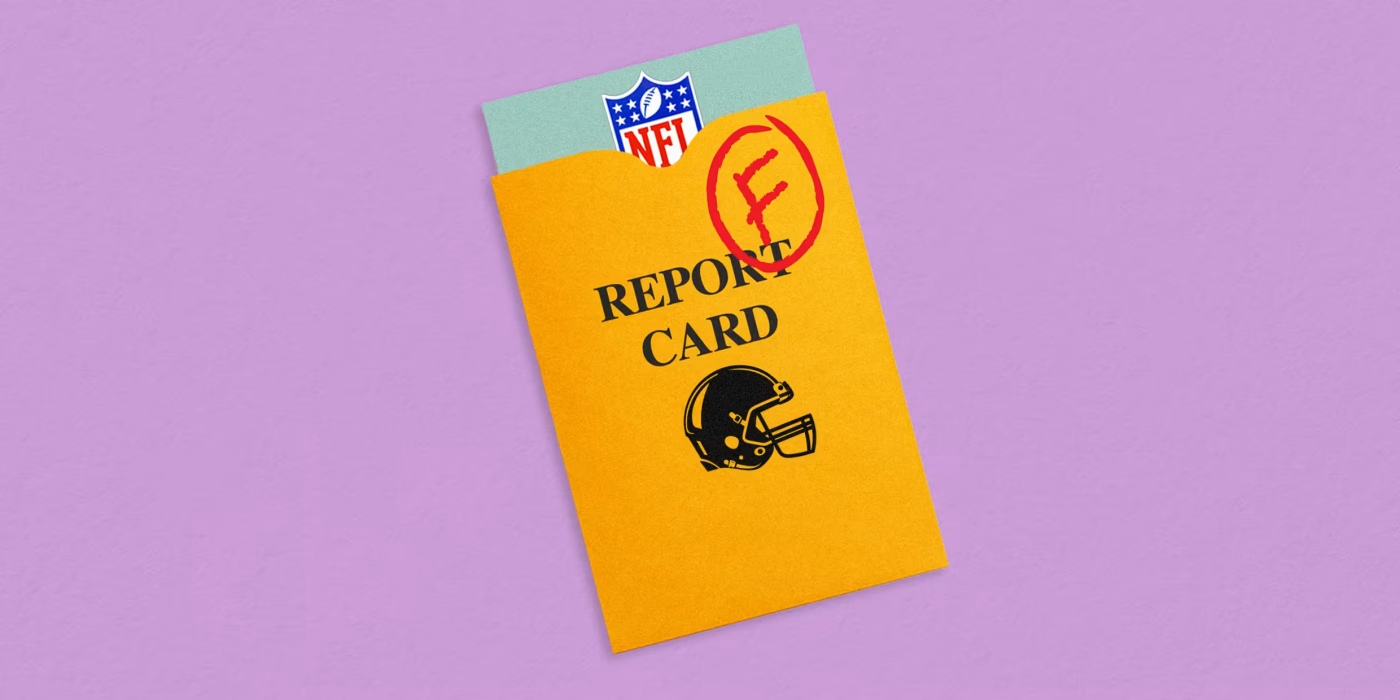
The NFL report cards have been a staple of the last few years. It allowed the public to view how the various teams around the league treated their players. If you were previously unfamiliar, the NFL Players Association (NFLPA) would publish a report card grading each team on things such as facilities, treatment of players, training staff, ownership, etc. The teams were rated by the players, and then the results were compiled and published. The grades range from an A+ through F-. [1] The NFLPA has stated two main goals: the first is to ensure that players know the environment of the team they will be working for, and the second is to give teams feedback so that they can improve. [2]
While the goal of the NFLPA may have been well intentioned, some NFL owners were not as pleased with their team’s grade when the report cards were published. New York Jets owner Woody Johnson was not happy with his team’s grading, so much so, that he filed a grievance under Article 51 of the Collective Bargaining Agreement (CBA). The NFLPA and the NFL owners are bound by the CBA, which lays out commitments that both the players and the owners have to follow. The CBA is negotiated every ten years, with the current agreement being in place through the 2030 season.[3] When an issue arises under the CBA, the owner or the players can file a grievance to be decided by a arbitrator. The arbitrator found in favor of the NFL, and ruled that the NFLPA will not be able to publish the findings of their report cards.
While the NFL owners view this as a win, it could have opened up a much larger can of worms for them. Johnson challenged the report cards under a clause of the CBA which requires that NFL owners and players take reasonable efforts not to publicly criticize the teams, their coaches, or a team’s operations and policy.[4] The arbitrator sided with the NFL, finding that the report cards violated the CBA because of their publicized criticism of the teams and individuals.[5]However, that ruling can cut both ways. Some NFL owners have recently publicly criticized active players on their rosters.
The arbitrator’s ruling limiting the publishing of the NFLPA’s report cards could have unintended consequences on the NFL owners. The arbitrators ruling relies on a clause of the CBA which prohibits NFL owners and players from criticizing each other publicly. What the owners did not consider when they won this ruling, is now players can file a grievance against them citing the same clause in the CBA. While there is no evidence of a current player filing a grievance under this clause, it is not outside the realm of possibility. Some players who could have viable claims under this ruling are Justin Fields and Keon Coleman.
In October, Jets owner Woody Johnson publicly criticized his quarterback Justin Fields, and more recently Bills owner Terry Pegula has made comments surrounding Keon Coleman’s selection in the draft. If the same logic is followed, both owners could be subject to a similar ruling, if the players decide to file a grievance under the CBA. It is one way that a player could hold an NFL owner accountable under the CBA. The NFLPA is not going to stop creating the report cards, however they will no longer be able to publish them.[6]However, it is important to note that it is still possible for the report cards to be leaked, due to the sheer size of the NFLPA. It will be hard for them to track who has access at any given time.
[1] https://nflpa.com/report-cards/2025
[2] https://nflpa.com/posts/the-third-annual-nflpa-club-report-cards
[4] https://www.espn.com/nfl/story/_/id/46953218/nfl-filed-grievance-nflpa-stop-report-cards
[5] https://www.espn.com/nfl/story/_/id/47920248/nfl-wins-grievance-nflpa-regarding-report-cards
[6] https://www.espn.com/nfl/story/_/id/47920248/nfl-wins-grievance-nflpa-regarding-report-cards

Leave a Reply