The Utah Jazz announced that Lauri Markkanen will miss two weeks after sustaining a hip injury during practice. This announcement raised alarms for many, given the heightened sense of animosity with the league over tanking. A premature report, which has since been walked back, suggested that Adam Silver was prepared to send an independent physician to verify Markkanen’s MRI results.[1] [2] The Jazz were already fined $500,000 for “conduct detrimental to the league” after benching Markkanen and Jaren Jackson Jr. for the entire fourth quarter of competitive games against Orlando and Miami.[3] Shortly afterward, Jackson Jr. was ruled out for the season to under-go knee surgery and Jusuf Nurkić was shut down for season‑ending nose surgery.[4] The clustering of these events created the perception that Utah’s medical decisions were entangled with competitive—tanking—incentives.
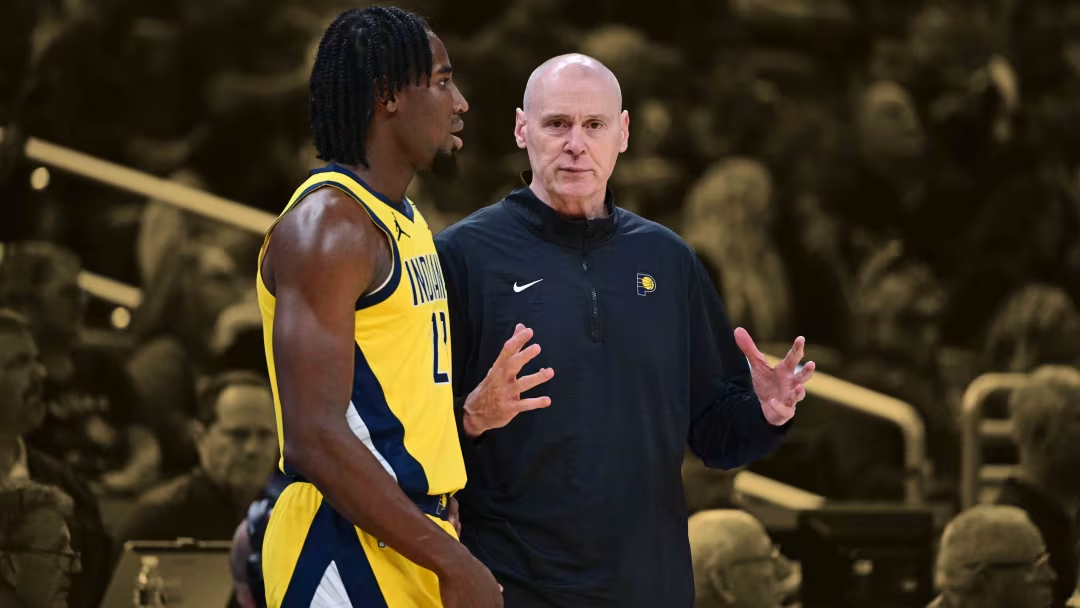
The developments in Utah came just days after Indiana Pacers Head Coach Rick Carlisle publicly accused the NBA of pressuring the team to play Aaron Nesmith despite legitimate injury concerns. The league had fined the Pacers $100,000 for violating the Player Participation Policy (PPP) after determining that Indiana failed to provide sufficient medical justification for ruling out Nesmith, along with Pascal Siakam and Andrew Nembhard. Carlisle defended the team’s decision, stating that Nesmith “couldn’t hold the ball.” He further claimed that league officials asked whether the Pacers had considered medicating Nesmith so that he could appear in a regular‑season game—an inquiry he emphasized was made in a season where Indiana sat “30 games under .500.”[5]
The NBA’s authority to investigate injury designations comes from the PPP and the commissioner’s authority to discipline any player, team, coach, or owner whose conduct is deemed detrimental to the best interests of basketball.[6] The PPP requires teams to provide a legitimate, documented medical basis for holding a player out and prohibits resting healthy players in circumstances that materially impact the league’s product.[7] The policy applies most strongly to “star players,” but it also governs any situation in which the league believes a team may be manipulating injury designations to influence competitive outcomes. When a team lists a player as out, the PPP obligates the club to supply medical documentation that satisfies league standards, and it authorizes the NBA to review that documentation, request additional information, or consult an independent physician if the justification appears inconsistent, incomplete, or strategically motivated.[8]
An investigation is triggered when the league has reason to question the credibility of a team’s injury designation or when a team’s actions raise concerns about competitive integrity. This includes patterns such as resting multiple rotation players on the same night, benching healthy players in competitive games, or providing medical explanations that do not align with the player’s recent activity or available documentation.[9] The league may also initiate review when a team is already under scrutiny or when the timing of an injury designation coincides with incentives to lose games, protect draft position, or manipulate betting markets. Once triggered, the PPP allows the NBA to request medical records pursuant to Article XXII of the CBA, evaluate whether the team’s justification meets the policy’s standards, and impose discipline if the explanation is deemed insufficient. The policy does not empower the league to declare a player healthy or force him to play; instead, it regulates the team’s reporting obligations and penalizes misrepresentation that undermines the integrity of competition.
The league’s increasingly assertive use of the PPP reflects a broader effort to police competitive integrity, but that enforcement authority is constrained by a detailed medical‑governance framework negotiated in the CBA. While the NBA can question the credibility of an injury designation and request documentation, its power stops well short of dictating medical outcomes. Article XXII of the CBA places important structural limits on the authority created by PPP. It requires each team to employ qualified medical professionals, restricts how and when medical information may be shared, and guarantees players the right to obtain independent second opinions at the team’s expense. Just as importantly, Article XXXI establishes the procedures for injury grievances and independent evaluations, ensuring that any league inquiry into a player’s health must proceed through a jointly governed process rather than unilateral league fiat.
These provisions collectively prevent the NBA from enforcing its own judgment over that of medical professionals, from compelling treatment, or from forcing a player to participate when he reports pain or functional limitation. In this way, the CBA functions as a doctrinal counterweight to the PPP: it allows the league to investigate potential misrepresentation, but it bars the league from dictating medical outcomes, preserving the primacy of player autonomy and clinical expertise.
Adam Silver has made it a point to crack down on perceived tanking efforts, but the Nesmith and Markkanen injuries are an important reminder that competitive integrity cannot come at the expense of player health. While deliberate tanking efforts warrant league intervention, teams retain the right to take additional precautions when a player reports pain or functional limitation. The legitimacy of a medical justification should not hinge on a team’s place in the standings; the standards governing injury designations must apply uniformly whether a club is contending for a top seed or sitting at the bottom of the conference. The PPP was created to ensure star-players play more often when most people are watching. It cannot be turned into a weapon used in Silver’s war against tanking.
[1] Hansen, J. (2026, February 26). Report: Adam Silver is sending independent doctors to verify Lauri Markkanen injury. Yahoo Sports. https://sports.yahoo.com/articles/report-adam-silver-sending-independent-051504736.html
[2] Hansen, J. (2026b, February 27). New details on the Adam Silver Utah Jazz tanking feud. SLC Dunk. https://www.slcdunk.com/utah-jazz-news/66948/new-details-on-the-adam-silver-utah-jazz-tanking-feud
[3] NBA fines Jazz, Pacers, says integrity can’t be compromised – ESPN. (2026b, February 13). ESPN.com. https://www.espn.com/nba/story/_/id/47914175/nba-fines-jazz-500k-pacers-100k-sitting-players
[4] Jusuf Nurkic to have nose surgery, miss rest of Jazz’s season – ESPN. (2026, February 24). ESPN.com. https://www.espn.com/nba/story/_/id/48018554/jusuf-nurkic-nose-surgery-miss-rest-jazz-season
[5] Rawat, S. (2026, February 25). NBA disputes Rick Carlisle’s comments on Pacers’ 6-Figure fine, says HC was “Inaccurate.” Yahoo Sports. https://sports.yahoo.com/articles/nba-disputes-rick-carlisle-comments-030855757.html
[6] National Basketball Association, Constitution and By‑Laws, art. 24 (2012).
[7] Weinstein, B. (2023, September 13). NBA Board of Governors approves new Player Participation Policy – NBA.com§: NBA Communications. NBA.com: NBA Communications. https://pr.nba.com/nba-board-of-governors-approves-player-participation-policy/
[8] Marks, B. (2023, October 10). How the NBA’s new rules on resting stars will work – ESPN. ESPN.com. https://www.espn.com/nba/story/_/id/38386013/how-nba-new-rules-resting-stars-work
[9] National Basketball Association, Player Participation Policy (2023).

Kaitlin Gruber is a second‑year law student at the University at Buffalo School of Law whose work focuses on sports law, collective bargaining, and the regulatory structures that shape professional basketball. Her research examines how legal doctrine intersects with competitive integrity in the NBA. She brings a lifelong love of basketball to her writing, exploring how legal rules shape the modern game.
Leave a Reply