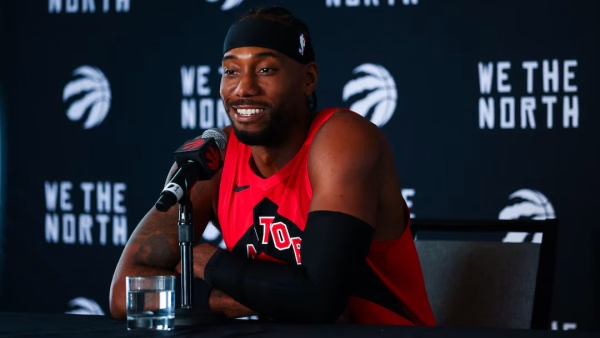
The NBA’s sanctions against the Los Angeles Clippers were sweeping, but they did not mark the end of the matter. Before the league announced its penalties, federal prosecutors in the Eastern District of New York began examining whether the conduct underlying the Clippers’ alleged salary cap circumvention also violated federal criminal law.[1] The factual... Continue Reading →
The Final Word: Contractual Due Process and Commissioner Authority in the NBA
The NBA’s historic discipline of the Los Angeles Clippers—five forfeited first‑round picks, a $30 million fine, and sweeping suspensions of senior leadership—initially triggered a wave of public debate about fairness, bias, and procedural rights.[1] The Clippers’ first response was combative: they denounced the league’s findings as “heavily biased” and “predetermined,” vowed to “vigorously challenge” the... Continue Reading →
The Invisible Hand of an Ungoverned Process: A Structural Critique of NBA Award Voting
As the NBA slowly unveils the winners of its postseason awards, the stakes extend far beyond bragging rights or résumé lines. These honors do more than crown the league’s best performers; they function as a wage‑setting mechanism with multimillion dollar consequences. A single All‑NBA selection can unlock a supermax contract, trigger bonus escalators, or reshape... Continue Reading →
Correcting the Call: How Misaligned Officiating and Discipline Undermine Institutional Trust in the NBA
A legitimate officiating system rests on more than the accuracy of individual calls. It requires consistency, transparency, coherence between internal and external processes, predictable standards, and proportional accountability. These principles form the governance baseline against which any modern sports league must be measured, especially in an era defined by real‑time video scrutiny, player empowerment, and... Continue Reading →
Award Eligibility as Wage Regulation: Rethinking the 65 Game Threshold in the Modern NBA
Introduced at the start of the 2023–24 season, the NBA’s 65‑game rule was designed as a load management countermeasure—an attempt to curb the rise of discretionary rest and respond to fans and broadcast partners frustrated by declining star availability across the 82‑game schedule. Three seasons in, the rule is facing its first meaningful stress... Continue Reading →
What Bobby Marks Learned From Two Decades Inside the NBA
I was fortunate to speak with Bobby Marks about the path that took him from an intern for the New Jersey Nets to one of the most recognizable analysts in the NBA. In our conversation, he reflected on the moments that shaped him, the lessons he learned across two decades inside the Nets organization, and... Continue Reading →
Conduct Detrimental to Whom? The NBA’s Image Driven Approach to Mental Health
The NBA currently has no standardized or enforceable protocol for addressing behavioral incidents categorized as “conduct detrimental to the team,” nor for responding to mental health concerns that arise in connection with injury. There is no requirement that a player receive a mental health evaluation before being disciplined, suspended, or waived, and the league has... Continue Reading →
The Disappearing 15th Man: How the CBA Quietly Rebuilt NBA Rosters
The NBA’s 2023 Collective Bargaining Agreement has quietly transformed the economics of roster construction, particularly for teams operating above the second apron. What once functioned as a soft cap system with workable mechanisms for adding depth has hardened into a landscape defined by austerity, where every marginal contract, every roster spot, and every day on... Continue Reading →
Who Owns the Sonics? The Continuity Rule, Cultural Claims, and the Thunder’s Inherited Past
By publicly announcing a 2026 deadline for making a formal decision on league expansion, the NBA is signaling that it is in the final phase of its expansion feasibility process. This process involves a multi‑stage evaluation of market strength, ownership readiness, financial modeling, and competitive‑balance implications. The feasibility process is designed to identify markets that... Continue Reading →
Two-Way Contracts as a Structural Win for the NBA’s Developmental Ecosystem
The two‑way contract, introduced in 2017 and expanded under the 2023 Collective Bargaining Agreement, represents one of the most consequential innovations in the NBA’s labor architecture. Far from a marginal roster mechanism, the two‑way system has become a central pillar of the league’s developmental strategy, reshaping the relationship between the NBA and the G-League while... Continue Reading →