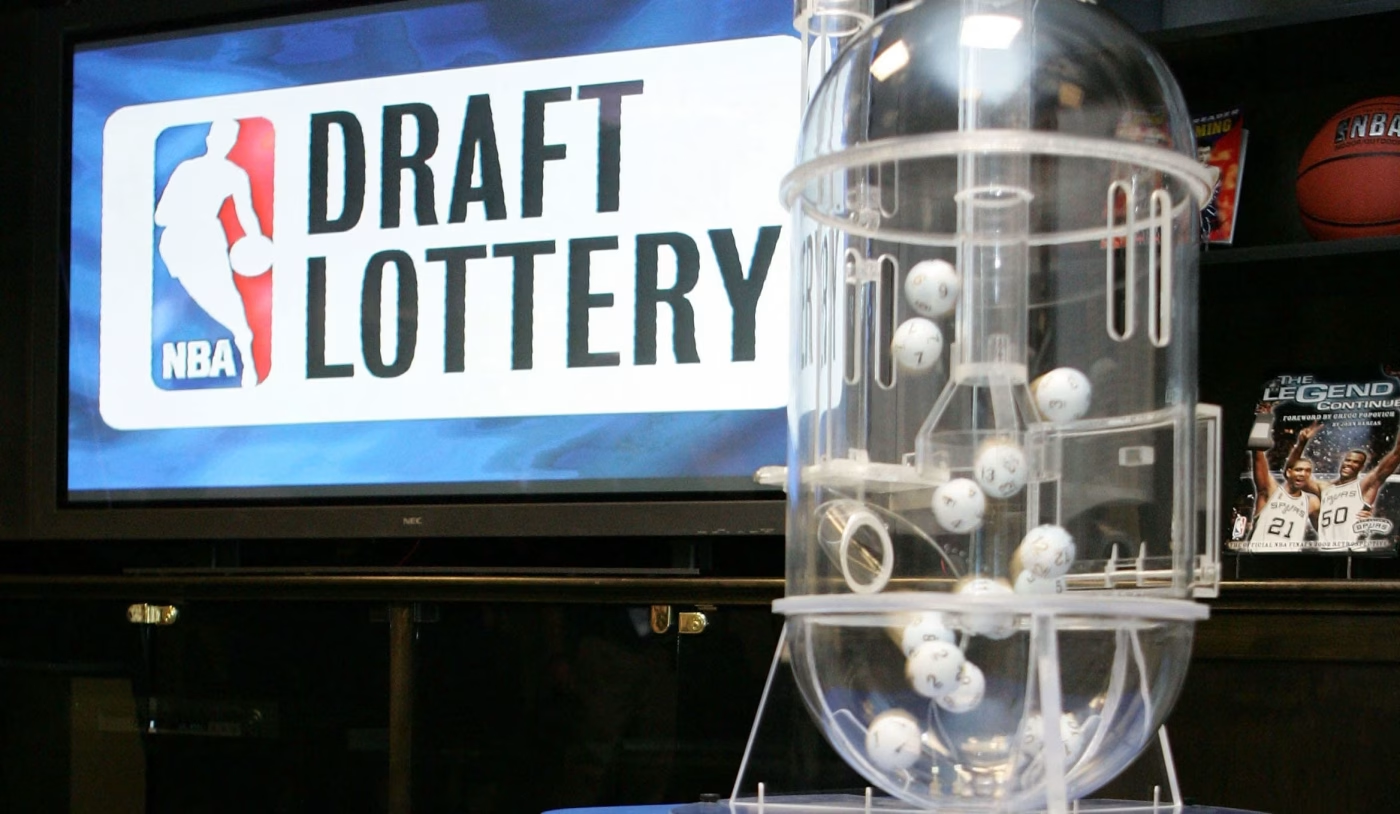
On Thursday, NBA commissioner Adam Silver informed the league’s 30 general managers that the NBA plans to implement anti-tanking rule changes beginning next season. The proposed solutions include: reserving the ability to protect draft picks only for top-four selections; freezing lottery odds at the trade deadline; prohibiting teams from picking in the top four in consecutive years; prohibiting teams from picking in the top four the year after making the conference finals; using two-year records to determine draft odds; including all play-in teams in the lottery; and flattening odds for all lottery teams.[i]
After fining both the Utah Jazz and Indiana Pacers last week for sitting players the league deemed healthy, the NBA signaled that it will not tolerate conduct it believes undermines the integrity of competition. From the league’s perspective, tanking is not merely a strategic choice but a governance problem—one the commissioner is empowered to address under his broad authority to prevent practices “not in the best interests of basketball.” Yet that authority exists alongside meaningful legal constraints. The NBA can police bad‑faith manipulation of competitiveness, but it cannot simply declare every unpopular roster decision a violation without risking overreach, inconsistency, or antitrust exposure.
Under U.S. antitrust law, anti-tanking rules implicate structural limits that drastically shape the league’s authority. The likely legal outcome of implementing anti-tanking rules depends on whether the reforms fall within the non-statutory labor exemption and whether the reforms fall within the Rule of Reason. Legal precedent strongly suggests that unless the NBA bargains these rules with the NBPA, they risk being treated as unlawful restraints of trade.
The Supreme Court has long recognized that certain restraints arising from collective bargaining are exempt from antitrust scrutiny: “restraints on competition lawfully imposed through the collective bargaining process are exempted from antitrust liability so long as such restraints primarily affect only the labor market organized around the collective bargaining relationship.”[ii] But this exemption applies only when the restraint primarily affects the labor market—that is, the relationship between players and teams.
Anti-tanking rules do not fit comfortably within this framework. Unlike salary caps, free-agency rules, or draft eligibility requirements, which regulate employment conditions, anti-tanking reforms regulate how independently owned franchises compete with one another for draft assets and long‑term strategic advantage. Because these rules operate in the sphere of inter‑team competition rather than the labor market, they fall outside the core of the non‑statutory labor exemption unless the NBPA affirmatively agrees to them.
Absent the labor exemption, anti-tanking rules must be evaluated under §1 of the Sherman Act. Courts treat agreements among independently owned sports teams as potential horizontal restraints, even when coordinated through a league office. In Los Angeles Memorial Coliseum Comm’n v. NFL, the Ninth Circuit held that the NFL’s restrictions on franchise relocation constituted a horizontal restraint because they coordinated the competitive behavior of rival clubs.[iii] Anti-tanking rules operate the same way. Freezing lottery odds, limiting pick protections, or restricting top-four selections are not employment rules; they are inter-team competitive restraints.
Adam Silver, as commissioner, has “broad authority to prevent any act, transaction or practice” not in the best interest of basketball.[iv] However, that authority is not absolute; antitrust law imposes meaningful limits on the NBA’s ability to unilaterally impose or enforce anti‑tanking rules. To survive the Rule of Reason, the NBA must demonstrate that any anti-tanking rule serves a legitimate pro-competitive objective, that the rule materially advances that objective, that it is narrowly tailored, and that no less restrictive alternative could achieve the same result.[v] Some proposals, such as further flattening lottery odds, may plausibly be defended as promoting competitive balance. But others—like barring teams from picking in the top four after a conference finals appearance—lack a coherent competitive‑balance rationale and risk being characterized as arbitrary or punitive.
The league has an interest in protecting the competitive integrity of basketball, but it must avoid adopting anti‑tanking rules that inadvertently punish teams who are not trying to lose. Effective regulation requires a careful balance: reforms must target deliberate strategic losing without disadvantaging chronically rebuilding franchises stuck in the lottery or penalizing competitive teams derailed by catastrophic injuries. Anti‑tanking policy, in other words, must distinguish between intentional manipulation of outcomes and the natural volatility of competitive sports, ensuring that the cure does not become more distortive than the disease.
[i] Charania, S. (2026, February 19). NBA plans to enact anti-tanking rules next season, sources say – ESPN. ESPN.com. https://www.espn.com/nba/story/_/id/47979919/nba-set-enact-anti-tanking-rules-next-season-sources-say
[ii] Brown v. Pro Football, Inc., 50 F.3d 1041, 1044 (D.C. 1995).
[iii] Los Angeles Memorial Coliseum Comm’n v. NFL, 726 F.2d 1381, 1388 (9th Cir. 1984).
[iv] Charles O. Finley & Co. v. Kuhn, 569 F.2d 527, 535 (7th Cir. 1978).
[v] Mackey v. NFL, 543 F.2d 606, 620 (8th Cir. 1976).

Kaitlin Gruber is a second‑year law student at the University at Buffalo School of Law whose work focuses on sports law, collective bargaining, and the regulatory structures that shape professional basketball. Her research examines how legal doctrine intersects with competitive integrity in the NBA. She brings a lifelong love of basketball to her writing, exploring how legal rules shape the modern game.
Leave a Reply