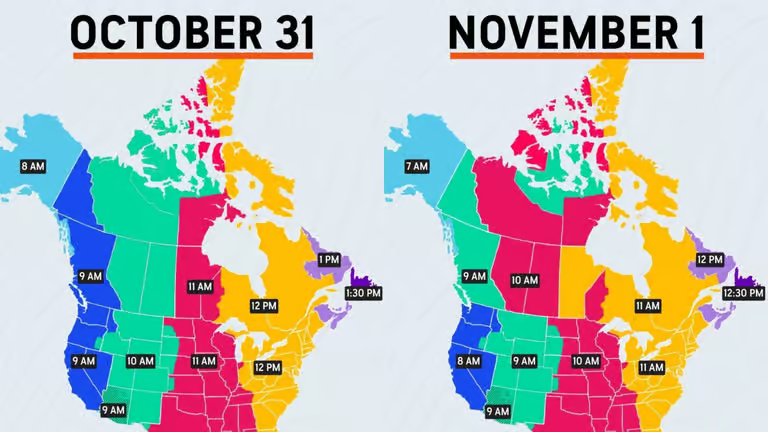
A one-hour time change might not seem like a major issue in professional sports, but for NHL teams, it can affect much more than when fans tune in. Changes to daylight saving time across Canada have created unexpected scheduling challenges for the league, particularly for teams in Western Canada. With game start times shifting, players adjusting their routines, and teams navigating different time zones, a seemingly simple government decision has raised questions about player welfare, collective bargaining, and even international taxation.
A Time Change That Reached the Ice
In 2026, several Canadian provinces moved away from seasonal clock changes and adopted year-round time standards. British Columbia, Alberta, and Manitoba made changes that affected how their local time aligned with the rest of North America. While the decisions were made at the provincial level, their effects extended into professional hockey. [1]
The NHL’s schedule is heavily influenced by television and broadcasting agreements, which means changes in local time can create problems for both teams and viewers. For the 2026-27 season, the Calgary Flames are scheduled to play eight games with 9 p.m. local start times, including two home games. The Edmonton Oilers face seven similar starts. Meanwhile, after Manitoba announced its decision during training camp, the NHL adjusted the start times of 12 Winnipeg Jets home games, moving them back an hour. [2]
These adjustments raise a practical question: How much control should a professional league have over its schedule when outside decisions directly affect the conditions under which its players compete?
Player Health, Recovery, and Performance
The issue goes beyond inconvenient game times. Professional athletes depend on consistent routines involving sleep, nutrition, training, and recovery. A later start time can push those routines back, particularly when players already face demanding travel schedules and consecutive games.
The concern is supported by research. A 2022 study examining more than 17,000 NHL regular-season games found associations between time-zone changes, longer travel distances, and negative effects on certain measures of team performance. The researchers emphasized the importance of managing circadian disruption and prioritizing recovery, particularly when teams play multiple games within 48 hours. [3]
Players have already acknowledged the adjustments required. Calgary Flames captain Mikael Backlund discussed adapting to the later starts, while Edmonton players described changing their sleep schedules, taking naps, and adjusting mealtimes. [2]
Although these changes do not establish that later games will necessarily cause injuries or poorer performance, they raise legitimate questions about how much responsibility teams and the league have to protect players’ recovery time.
What Does the Collective Bargaining Agreement Say?
This is where the issue becomes particularly interesting from a sports law perspective. The NHL and the NHL Players’ Association operate under a collective bargaining agreement (CBA) that addresses scheduling, practice sessions, and travel requirements.
Article 16 of the CBA establishes several protections for players. For example, Section 16.7 generally prohibits the NHL from scheduling regular-season or playoff games before noon local time without NHLPA consent. Section 16.8 also addresses travel restrictions and requires players to receive at least nine hours off overnight between arriving at a hotel during a road trip and their next required team activity, subject to certain exceptions. [4]
These provisions demonstrate that scheduling and recovery are already recognized as important labor issues in professional hockey. However, they do not specifically address the consequences of provincial time changes, or the additional challenges created by unusually late game starts.
The question is whether existing protections are enough when the conditions surrounding a team’s schedule change outside the league’s control. Should the NHL and the NHLPA consider additional scheduling or recovery protections when regional time changes create unusual demands on players? It is worth considering whether these issues should become part of future collective bargaining discussions.
The Cross-Border Tax Complication
There is another layer to consider: Canadian taxation. Because the NHL operates across the United States and Canada, players regularly travel internationally to perform their jobs. When a player participates in a game in Canada, the income associated with those services may raise Canadian tax considerations, even if the player lives and plays for a U.S.-based team. [5]
The Canada-U.S. tax treaty addresses this issue. Under Article XV, employment income may be taxed in the country where the employment is performed, subject to certain exceptions. Importantly, Article XVI specifically addresses professional athletes and provides that its general athlete-income rules do not apply to employees of teams participating in leagues with regularly scheduled games in both countries. Instead, the employment-income provisions generally govern. [5]
This creates additional tax considerations for players who perform services on both sides of the border. Their tax obligations can depend on factors such as residency, where employment is performed, and the applicable treaty provisions.
Although daylight saving time itself does not change a player’s tax liability, the broader scheduling and cross-border issues highlight how professional sports operate within multiple legal systems at once.
What Does This Mean for the NHL?
The NHL’s scheduling challenges illustrate how decisions made outside professional sports can have consequences for the league, its teams, and its players. A change to the clock may seem minor, but when it affects game times, travel, recovery, and broadcasting, it becomes a much larger operational issue.
The league cannot control how individual provinces regulate time, but it can consider how those decisions affect its scheduling responsibilities and obligations to players. The CBA already recognizes that travel and recovery matter. As professional sports become increasingly interconnected across borders, those protections may need to account for circumstances that were not originally anticipated.
At the end of the day, the game may still start at the same time on the scoreboard, but the demands placed on the players getting there can look very different.
Sources
[1] Statistics Canada, “Time in Canada: Not so standard,” November 4, 2026.
[2] Associated Press, “Permanent daylight time brings quirky NHL start times to Western Canada,” October 8, 2026.
[3] “Associations between time zone changes, travel distance and performance: A retrospective analysis of 2013–2020 National Hockey League Data,” Journal of Science and Medicine in Sport, Vol. 25, Issue 12 (2022).
[4] National Hockey League and National Hockey League Players’ Association, Collective Bargaining Agreement, Article 16, Sections 16.6–16.8 (2013), as incorporated into the 2026–2030 CBA through the June 27, 2025 Memorandum of Understanding.
[5] Canada–United States Tax Convention Act, 1984, Schedule I, Articles XV and XVI.
[6] Winnipeg Jets, “Start time updates for 12 Winnipeg Jets home games,” September 18, 2026.
[7] Government of Alberta, “Alberta’s new time system (ABT).”

Leave a Reply