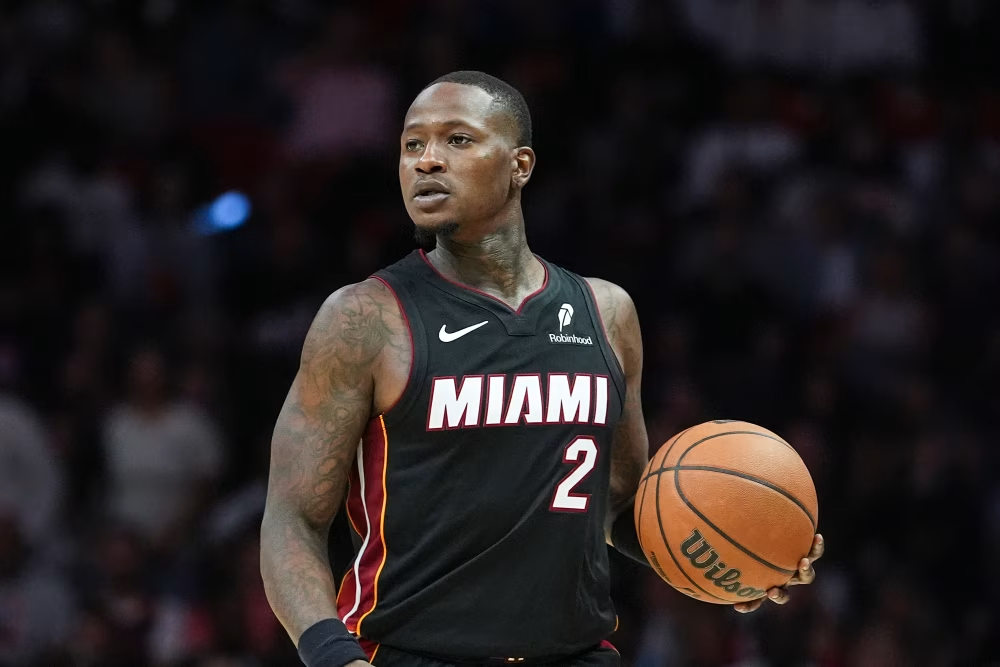
The NBA’s newly announced betting restrictions arrive at a moment when public frustration with the prevalence of gambling in sports is reaching a peak. In a memo to its sportsbook partners, the league prohibited a narrow set of bet types—most notably single‑player under parlays, alternate under lines, and wagers tied to opening tips or missed shots. On paper, the move signals a heightened commitment to protecting competitive integrity. In practice, it raises a more complicated question: does this rule change meaningfully reduce the risks that modern betting markets pose to the sport, or does it simply create the appearance of reform without altering the underlying dynamics?
The timing is not accidental. The NBA’s betting restrictions are a direct response to two federal criminal cases that exposed how modern wagering markets can be exploited through micro‑manipulation, rather than traditional game fixing. In both the Jontay Porter and Terry Rozier matters, bettors used single‑player under parlays to profit from players exiting games early. As the league memo acknowledges, these wagers were “low likelihood, high payout bets,” a structure that creates outsized incentives for insiders to manipulate individual stat lines rather than the competitive outcome of the game.[1]
The Porter case was particularly damaging. Federal prosecutors detailed how a bettor placed an $80,000 parlay on the under for Porter’s assists, rebounds, points, 3‑pointers, steals, and blocks—a wager that would have paid approximately $1.1 million. Porter, then on a two‑way contract, left the game after three minutes. The Rozier case followed a similar pattern: unders across multiple categories, a sudden early exit, and a betting scheme that federal authorities allege was coordinated to exploit the architecture of player‑specific parlays. Together, these cases demonstrate that the integrity threat in the modern betting climate is no longer confined to point shaving or match fixing; it now includes subtle, individualized manipulation that is easier to execute and far harder to detect.
In the immediate aftermath of the Porter scandal, the league banned unders on two‑way players and players on 10‑day contracts, recognizing that lower‑salaried, fringe roster players are statistically the most vulnerable to financial coercion or pressure from bad actors seeking to fix minor statistics.[2] This initial restriction created the foundation for the league’s newest expansion of the policy—an acknowledgment that the vulnerabilities exposed in the Porter and Rozier cases were symptoms of a broader structural weakness in the NBA’s betting ecosystem.
The NBA’s latest rule change builds on that foundation by imposing a narrow but deliberately targeted set of restrictions on sportsbook offerings. The centerpiece of the reform is the prohibition on single‑player under parlays—the precise mechanism used in the Porter and Rozier schemes. These wagers allowed bettors to stack multiple unders on a single player’s stat line, producing “low likelihood, high payout bets” that reward subtle manipulation rather than overt game fixing. By removing this category entirely, the league has closed the most direct pathway through which recent criminal conduct occurred.
The memo also directs sportsbooks to stop offering unders for players expected to play fewer than twelve minutes. This expands the logic of the league’s earlier ban on unders for two‑way and 10‑day players, recognizing that individuals with volatile or limited minutes are uniquely vulnerable to exploitation. When a player’s role is inherently unstable, the line between legitimate rotation decisions and manipulation becomes harder to police. Eliminating unders in these contexts reduces the risk that insiders can profit from early exits or minute management decisions that fall below public expectations.
Beyond unders, the NBA has prohibited several niche markets that can be influenced through low‑visibility actions: bets on the opening tip, wagers on players missing specific shots, and alternate under lines with inflated payouts. These markets do not drive significant betting volume, but they present integrity risks because they can be manipulated without affecting the competitive outcome of the game. A mistimed jump ball or an intentional missed shot is far easier to conceal than point shaving or coordinated match fixing. Removing these bet types reduces opportunities for micro‑manipulation that fall outside traditional integrity monitoring—behavior that is difficult to detect in real time and even harder to prove after the fact.
The memo pairs these prohibitions with enhanced compliance measures. Former NFL player and retired FBI agent Charles Tillman will lead in‑person training on sports betting rules, and the league is expanding its AI‑based monitoring system to detect unusual betting activity. The NBA is also implementing new protections for players and personnel, including updated fan conduct rules, a text‑based reporting hotline, and a partnership with Social Protect to identify and remove harassing messages. These steps do not change the betting markets themselves, but they improve the league’s capacity to identify patterns that may indicate manipulation. They also signal to regulators and the public that the NBA is investing in compliance systems commensurate with the risks created by legalized sports betting.
These targeted reforms strengthen the NBA’s integrity framework in meaningful ways. They reduce incentives for micro‑manipulation, close the loopholes exploited in recent criminal cases, and improve the league’s ability to detect unusual betting activity. In this narrow sense, the reforms work. They make the sport marginally safer from the specific risks that have already materialized.
Yet the selective scope of the rule change reveals its limitations. The NBA has not altered the high‑volume betting markets that define the modern fan experience, nor has it addressed the cultural and structural pressures created by tying individual player performance to widespread financial speculation. Player props, overs, same game parlays, and live betting remain untouched—markets that generate revenue, drive engagement, and expose players to harassment, insider information vulnerabilities, and emotional volatility from bettors. The league’s commercial partnerships with sportsbooks further constrain its regulatory posture, creating an inherent tension between protecting competitive integrity and preserving the economic engine that gambling has become.
The narrowness of the reforms is therefore not incidental; it reflects the league’s broader strategy for managing the political and cultural pressures surrounding legalized sports gambling. The memo’s restrictions allow the NBA to present itself as proactive and vigilant without materially altering the betting ecosystem that now underpins significant portions of its commercial model. In this sense, the rule change operates as an optics play—an effort to demonstrate responsiveness, reinforce public trust, and signal institutional seriousness while avoiding reforms that would meaningfully disrupt revenue or fan engagement.
The result is a hybrid reform: part integrity safeguard, part optics play, and part acknowledgment of the political sensitivity surrounding sports betting. The NBA can credibly claim that it has acted—and in the narrowest sense, it has. But the deeper vulnerabilities remain. The sport continues to operate within a betting ecosystem that incentivizes speculation on individual performance, amplifies the stakes of every possession, and exposes players to pressures that extend far beyond the court.
The league’s response to the Porter and Rozier cases addressed only the immediate causes, leaving the underlying condition intact. The next integrity challenge will not necessarily arise from the bet types the NBA has now prohibited; it will emerge from the broader dynamics the memo leaves untouched. As gambling becomes increasingly embedded in the NBA’s commercial and cultural identity, the league’s regulatory posture will need to shift from targeted fixes to structural reform. Whether it is willing or able to make that transition remains the defining question.
[1] David Purdum, NBA Tells Sportsbooks to Stop Certain Bets, Restrict Parlays, ESPN (Oct. 16, 2026, 11:00 AM).
[2] Andy Backstrom, NBA, Sportsbooks Reportedly Agree to Ban Certain Bets, Including Parlays Involving the Under on Same Player’s Stats, Yahoo Sports (Oct. 16, 2026, 1:09 PM).

Kaitlin Gruber is a third year law student at the University at Buffalo School of Law whose work focuses on sports law, collective bargaining, and the regulatory structures that shape professional basketball. Her research examines how legal doctrine intersects with competitive integrity in the NBA. She brings a lifelong love of basketball to her writing, exploring how legal rules shape the modern game.
Leave a Reply